Hytacotherium, aka Eohippus (the dawn horse)
The first known relative of the modern day Horse, the Eohippus lived in Europe and the Americas during the early Eocene Epoch (56-33 million years ago). Other modern animals that are descendants of the Eohippus are Rhinocerous and Tapirs
Standing at around 1-2 feet tall (30-60 cm) at the shoulder, with its skull varying depending on species. With four toes on the front feet and three on the back, it is theorized this slender mammal relied on it's speed and traction to flee from predators. An interesting difference from modern day horses is the Eohippus's teeth structure, with small incisors and low crowns that indicate this animal fed on leaves rather than grasses.
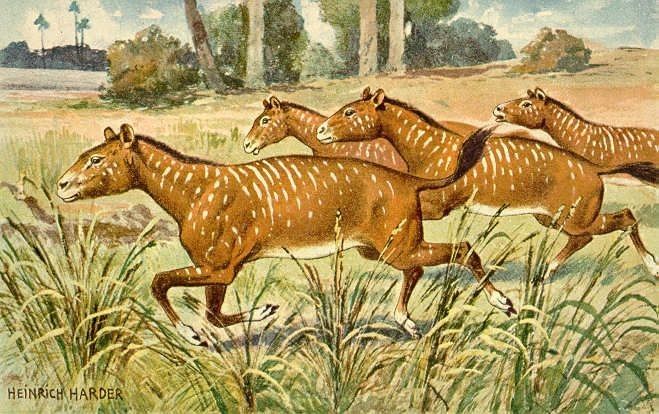
Fun Fact: the early Eohippus fossil was mistaken for a new species of monkey, how silly!
The Evolution to the Modern Day Horse
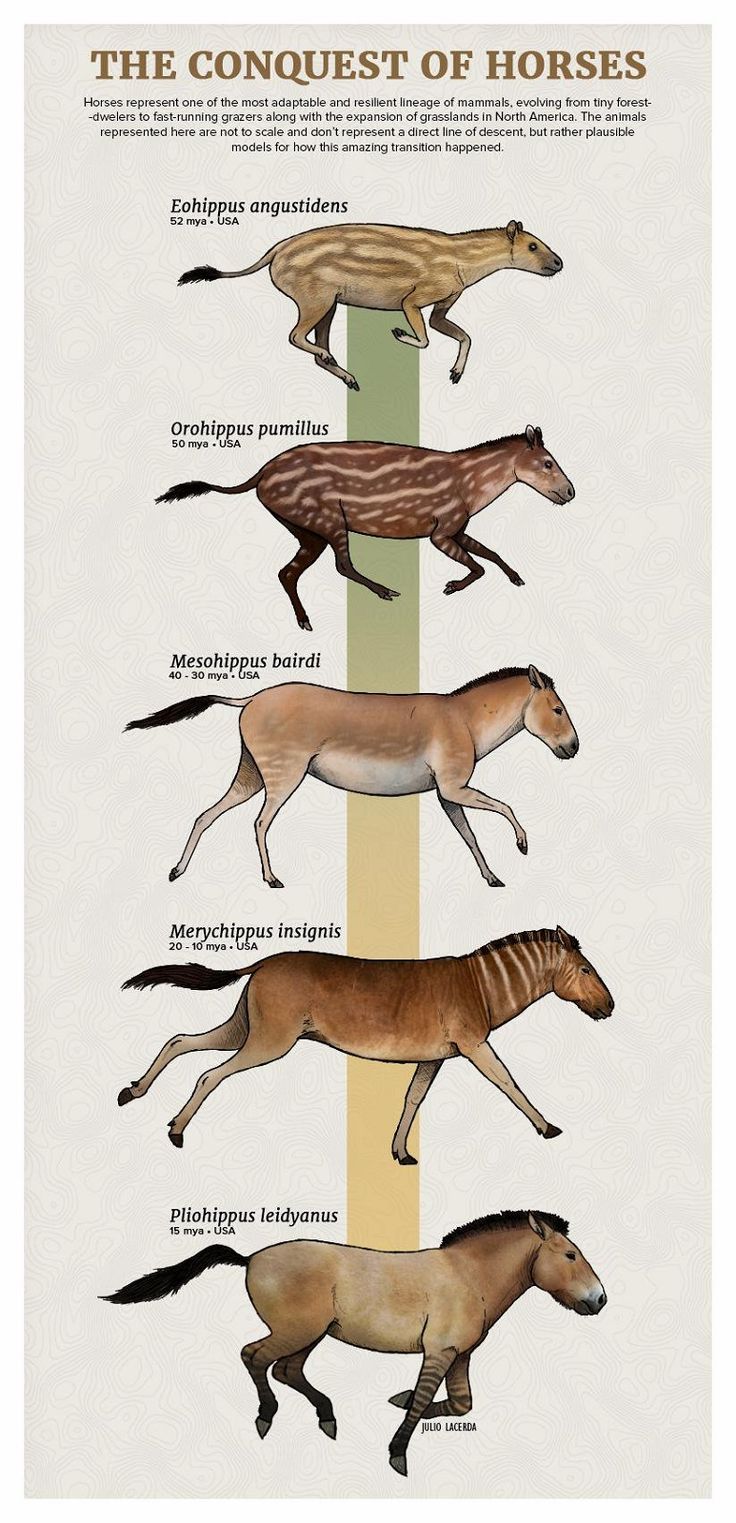
The Orohippus, from the middle Eocene, and the Epihippus, from the late Eocene, are descendants of the Eohippus. They resemble their predecessor in size and structure, but a major change was with their teeth and jaw. Now baring a striking resemblance to other browsing and grazing animals of the Eocene period, the Orohippus and Epihippus had evolved to diverge from a diet of leaves to grasses and ground foliage.
Fossils of the Mesohippus, from the early and middle Oligocene period, were found in North America. Far more horse-like than their ancestors, Mesohippus had long and slender legs along with a larger brain! With this descendant, they had completely changed their muzzle to have a fleshy covering on their snout and lips, fully adapted to browzing. Their toes also had a large change, with a complete loss of the front fourth toe and shortening of the footpad.
By the late Oligocene period, the Mesohippus had evolved into the larger Miohippus. The Miohippus had several evolutionary branches diverge from it, but the branch that included what later turned into the modern day horse was known as the anchitheres branch. The Miohippus later traveled from North America to Eurasia using the Bering Straight.
In the early Miocene we saw our first glimpse of the modern day horse, known as the Parahippus. This was the first descendant that had fully evolved to eat and digest grass, with a new jaw, tooth, and digestive structure. However, this change was perfected in the Merychippus, which came during the middle to late Miocene. This species looked much more like a pony than their odd cloven hooved ancestors, with most of their foot pad being completely gone. This mutation is still seen in modern horses, and was the primary catalyst for their swift running.
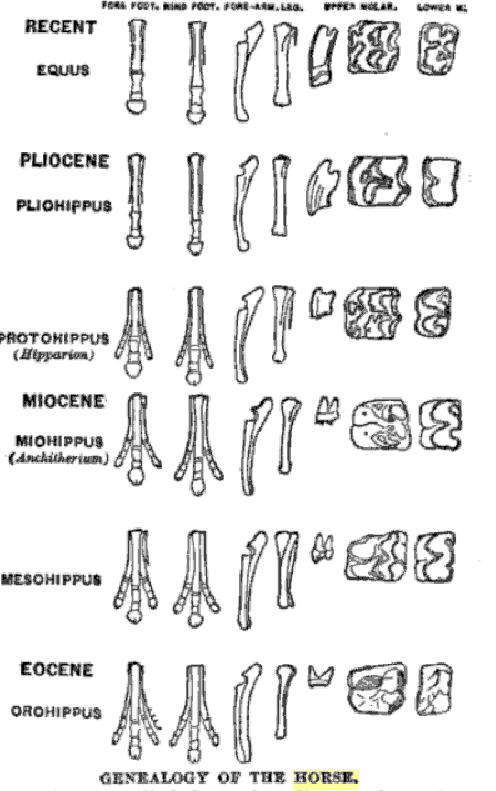
While Merychippus had numerous evolutionary lines, one led to the development of two toes, that being the Pliohippus. Pliohippus fossils have been found throughout the Pliocene beds in North America, and not much else has been found. However, during the Pliocene era rose the Equus, the genus where all equines reside (including but not limited to horses, zebra, and donkeys). The Equus shows great development in the spring mechanism of the foot, allowing even faster running than before. The leg bones are completely fused, and a singular hoof.
Scholors speculate the reason this species went extinct so quickly despite it's exceptional evolutionary changes was because of disease and human hunting. Many continents would remain without any Equus descendants until much later, when Spanish boats bring them over for exploration.